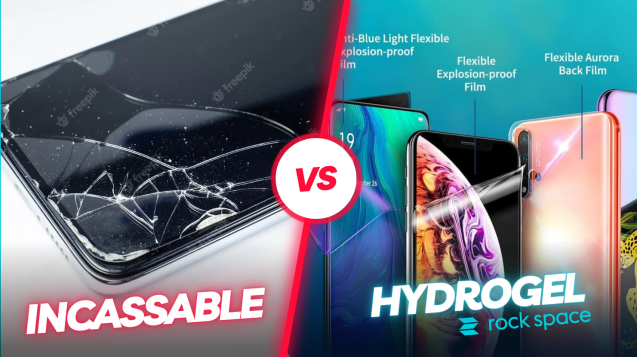
If two phone protectors have been compared time and again, they are Hydrogel® protectors and shatterproof ones. Both are widely used, but there are clear differences between the two. In this article, we’ll find out which one you should choose for better protection of your smartphone.
Shatterproof and its difficult relationship with curved screens
As we saw in the article explaining what Hydrogel® is, one of its most remarkable characteristics is its adaptation to any type of screen, whether flat or curved. This is not the case with tempered glass.
When a tempered glass protector is used on a curved screen, its rigidity prevents it from covering the entire screen, leaving a bare edge. However, thanks to its flexibility, Hydrogel® can adapt to curves, ensuring complete screen coverage.
Impact Protection
When tempered glass is impacted and shattered, caution is required, as the name suggests, it is glass that can shatter into many small pieces, potentially causing injury when removed or handled.
Hydrogel®, on the other hand, has a different response to shocks thanks to its soft surface. It absorbs impact and can regenerate, leaving the protector looking like new. Furthermore, removing it is easy; simply pull it off and the protector comes off easily.
Fingerprint Reader Problems
It’s becoming increasingly common for smartphones to integrate the fingerprint reader directly into the screen. The choice of protector can then influence the reliability of fingerprint reading. This is mainly due to the thickness of the protectors.
Hydrogel®, with its minimal thickness, facilitates flawless fingerprint reading. On the other hand, thicker tempered glass can make fingerprint reading difficult or even impossible. If your smartphone has an in-screen fingerprint reader, consider this factor when making your choice.
Hydrogel® as a back protector
Another notable difference is the versatility of Hydrogel® compared to tempered glass. While the latter can only be applied to the screen, Hydrogel® can be used on both the front and back of your smartphone, tablet, or laptop, providing protection against bumps and scratches. In addition, there are different Hydrogel® designs for the back, allowing you to personalize your phone and give it a unique touch.
Precise installation of Hydrogel® versus tempered glass
You may have heard that installing Hydrogel® is more complex. In some specific cases, especially with curved phones, to achieve a perfect finish. However, by following the steps correctly, it is possible to quickly install Hydrogel® without any bubbles.
As for tempered glass, it’s true that installation is faster: simply take the sheet, adjust it to the screen, and place it. However, it’s more likely to encounter bubbles or obtain an imperfect finish, unlike Hydrogel®, which offers a smoother result.
Is tempered glass cheaper than Hydrogel®?
This is undoubtedly the difference that generates the most controversy. While this price difference may encourage you to opt for tempered glass, it’s important to consider the long term.
As mentioned, Hydrogel® reacts differently to impacts. While glass shatters when subjected to impact, Hydrogel® absorbs the impact and regenerates over time, maintaining optimal protection. Additionally, Hydrogel® protects your entire smartphone, whereas tempered glass won’t fully cover a curved screen.
Finally, if after learning about all these differences between tempered glass and hydrogel, you’re still unsure about your choice, we offer you a resistance test that we conducted on both types of protectors, to dispel your doubts. We have our winner without a doubt!